
Feasibility study
A bounded, fixed-scope answer to "can this be measured, and how well?" — including simulation and, where relevant, testing on your sample.
Best when the question is still open.
Optical measurement attracts optimistic claims. The method below exists to make sure that whatever ends up in a datasheet is something that was actually measured — and that you can see it coming long before the invoice does.
| # | How a project runs | Exit |
|---|---|---|
| 01 | Frame the problemWhat is the sample, what has to be measured, at what accuracy, and in what environment? Most bad projects go wrong here, not later. | A written problem statement and success criteria. |
| 02 | FeasibilityA physics-level assessment, backed by simulation and, where useful, a quick bench test on your real sample. | Feasibility report, a clear go / no-go, and the expected performance envelope. |
| 03 | Design & prototypeOptical architecture, prototype hardware — largely 3D-printed in-house, so a layout can be revised between two mornings — and a first acquisition and processing chain. Built to answer questions, not to look finished. | A working prototype and the data it produces. |
| 04 | ValidateBenchmarking against an accepted reference method, on real unprepared samples, across the range you actually operate in. | Validation dataset, statistics, and an honest statement of limits. |
| 05 | Industrialise & hand overProduction-ready software, integration into your process or product, documentation, and training for whoever maintains it next. | Source, documentation, and a team that does not need me. |
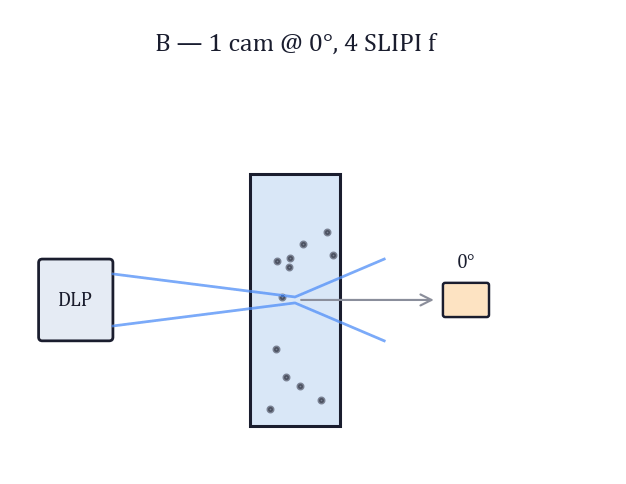
A physics-level assessment, backed by simulation and, where useful, a quick bench test on your real sample.
ExitFeasibility report, a clear go / no-go, and the expected performance envelope.
A bounded, fixed-scope answer to "can this be measured, and how well?" — including simulation and, where relevant, testing on your sample.
Best when the question is still open.
End-to-end technical development of an instrument or subsystem, run in milestones with a deliverable at each one.
Best when there is a product to build.
A recurring share of my time as your optics and measurement function — design reviews, algorithm work, firmware, and the awkward questions.
Best when the need is continuous.
Every performance figure traces back to a dataset and a reference method. If the data is not there yet, the claim is not made yet.
No amount of processing recovers information the optics never collected. That is why design starts at the radiometric budget.
Diluted and filtered samples make instruments look good. Industrial liquids do not arrive diluted or filtered.
Source, models, design files and reasoning are handed over documented. No black boxes that only work while I am available.
If a direction stops being viable, you hear it that week — not at the milestone review.
A one-person practice cannot hide behind a team, and would not want to. You work with the person doing the work.
A feasibility study costs a fraction of a development programme, and tells you whether to run one at all.
Scope a feasibility study